Baby Development Milestones: Month by Month (0–12 Months)
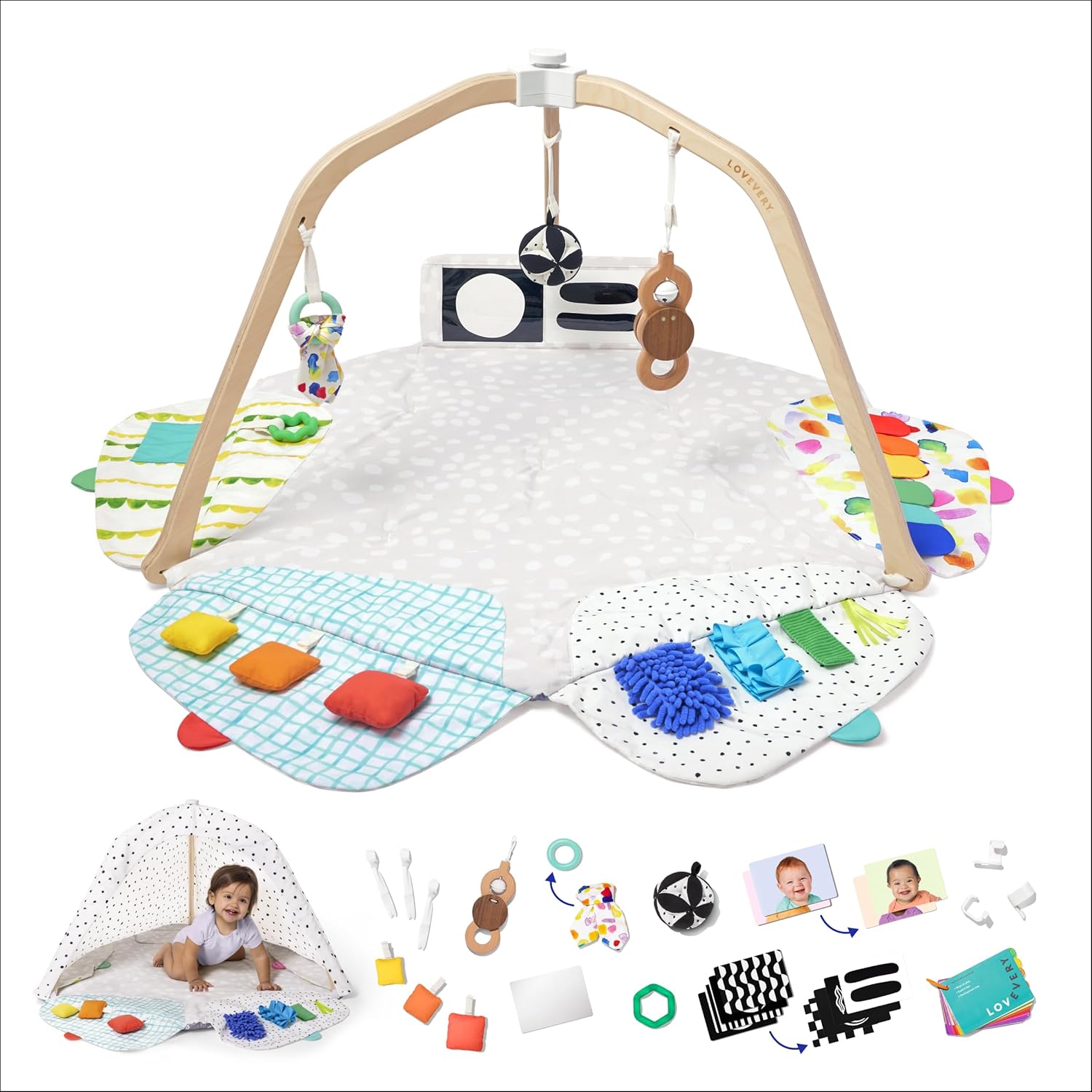
Baby development milestones are descriptions of what most babies can do at a given age. not checklists your baby must pass. Development is not linear and not uniform. A baby who rolls at 3.5 months may not babble until 7 months; another may skip rolling entirely and go straight to sitting. The ranges reflect normal variation in healthy development.
Important: corrected age for premature babies
If your baby was born prematurely, use their corrected age (chronological age minus weeks premature) for all developmental milestones until 24 months. A baby born 8 weeks early who is 6 months old has a corrected age of 4 months, compare against 4-month milestones, not 6-month ones.
0–2 Months: The Newborn Stage
| Domain | What to expect |
|---|---|
| Physical | Lifts head briefly during tummy time · Startles at loud sounds (Moro reflex) · Clenches fists · Turns head toward sound · Follows high-contrast objects close up (20–30cm) |
| Social/Emotional | First social smile appears 4–8 weeks · Calms when picked up · Stares at faces intently · Brief eye contact |
| Communication | Cries to communicate all needs · Different cries for hunger, discomfort, tiredness · Begins cooing (vowel sounds) from 6–8 weeks |
| Cognitive | Recognises parent's voice from birth · Prefers high-contrast black/white patterns · Tracks moving objects briefly |
🚨 Red flags at 2 months, see your paediatrician if:
Not responding to loud sounds · Not fixing gaze on faces or following movement · Not smiling by 8 weeks (adjusted) · Extreme stiffness or floppiness in muscle tone · No quieting or smiling in response to your voice
2–4 Months: Smiles and Social Connection
| Domain | What to expect |
|---|---|
| Physical | Holds head steadily at 90° during tummy time · Pushes up on forearms · Hands open (fists unfurl) · Swipes at dangling objects · May begin to roll tummy to back (3–4 months) |
| Social/Emotional | Clear social smile · Laughs aloud (3–4 months) · Shows excitement (kicks and waves arms) · Recognises familiar faces · Enjoys play, cries when play stops |
| Communication | Babbles and coos · Varies pitch · Begins to imitate facial expressions and sounds · Turns toward your voice |
| Cognitive | Reaches for objects · Tracks objects across midline · Recognises familiar objects at a distance · Interested in mirrors |
🚨 Red flags at 4 months, see your paediatrician if:
Not smiling at people · Doesn't follow moving things with eyes · Doesn't hold head steady · Not making sounds · Doesn't bring hands to mouth · Not pushing down with legs when feet placed on firm surface
4–6 Months: Rolling and Reaching
| Domain | What to expect |
|---|---|
| Physical | Rolls front to back and (later) back to front · Pushes up on extended arms · Sits with support · Bears weight on legs with support · Reaches and grasps with both hands · Transfers objects hand to hand (5–6 months) |
| Social/Emotional | Clearly distinguishes familiar people from strangers · First signs of object permanence · Enjoys social play and mirror play · Begins to show emotion more clearly |
| Communication | Babbles with consonant sounds ("ba", "da", "ma") · Responds to own name · Makes sounds to express joy and displeasure · Vocalises back and forth with carer |
| Cognitive | Reaches for objects out of reach · Explores with mouth · Shows curiosity · Watches path of an object when it falls · Recognises familiar people at a distance |
🚨 Red flags at 6 months, see your paediatrician if:
Doesn't try to reach for things · Doesn't respond to sounds · Difficulty getting things to mouth · Doesn't roll in either direction · Doesn't seem affectionate with familiar people · No babbling
6–9 Months: Sitting and Babbling
| Domain | What to expect |
|---|---|
| Physical | Sits independently (7–8 months) · Begins crawling, or bottom shuffling, which is equally valid · Pulls to standing (8–10 months) · Pincer grip developing (thumb + finger) · Bangs, shakes, drops objects to explore |
| Social/Emotional | Separation anxiety peaks (7–10 months) · Stranger anxiety develops · Enjoys peek-a-boo · Plays interactive games · Tests reactions by dropping things |
| Communication | Long babbling strings ("bababababa") · Says "mama" and "dada" without meaning (6–8 months) · Begins to say them with meaning (8–10 months) · Understands "no" · Points at objects of interest |
| Cognitive | Object permanence established, looks for dropped toys · Imitates gestures · Tests cause and effect · Begins to understand object function |
🚨 Red flags at 9 months, see your paediatrician if:
Doesn't sit with help · Doesn't bear any weight on legs · Doesn't babble · Doesn't respond to own name · Doesn't recognise familiar people · Doesn't point or gesture · Shows no interest in interaction games
9–12 Months: Cruising and First Words
| Domain | What to expect |
|---|---|
| Physical | Cruises along furniture · May take first steps (9–15 months, wide range is normal) · Pincer grip refined · Stacks 2 blocks · Claps hands · Waves bye-bye |
| Social/Emotional | Strong preference for familiar carers · May be very shy with strangers · Shows object to carer (sharing attention) · Imitates actions during play · Shows affection (hugs and kisses) |
| Communication | First words with meaning (10–14 months) · Vocabulary of 1–3 words at 12 months · Understands 10–50 words · Points to request and share · Shakes head "no" |
| Cognitive | Uses objects correctly (cups to drink, phone to ear) · Finds hidden objects easily · Imitates actions · Shows object permanence fully · Begins simple problem-solving |
🚨 Red flags at 12 months, see your paediatrician if:
Doesn't crawl or is very unequal on one side · Doesn't pull to stand · Doesn't use single words ("mama", "dada") · Doesn't gesture (point, wave, show) · Doesn't search for objects they see you hide · No back-and-forth sharing of sounds/smiles/facial expressions
Important: Red Flags at Any Age
Regardless of age, see your paediatrician promptly if your baby:
- Loses skills they previously had, regression in motor, communication or social skills at any age is a red flag
- Shows no interest in faces or social interaction
- Has very unusual muscle tone (very floppy or very stiff)
- Has asymmetric movement, consistently favouring one side
- Has stopped making progress for more than 4–6 weeks in any domain
Red flags do not mean something is definitively wrong, they mean an assessment by a paediatrician or developmental specialist is warranted. Early identification of any developmental difference is always better than watchful waiting.